
Delusions
and mirages

It’s the time of year when lake shore mirages often appear on sunny warm days of calm winds. A few days ago I was on the Cayuga County shoreline and noted the distant appearance of several large low lying islands in the northeast. I suspect I was seeing elevated areas of distant Tug Hill looming up behind Mexico Bay’s shoreline. When I looked again ten minutes later the “islands” had vanished.
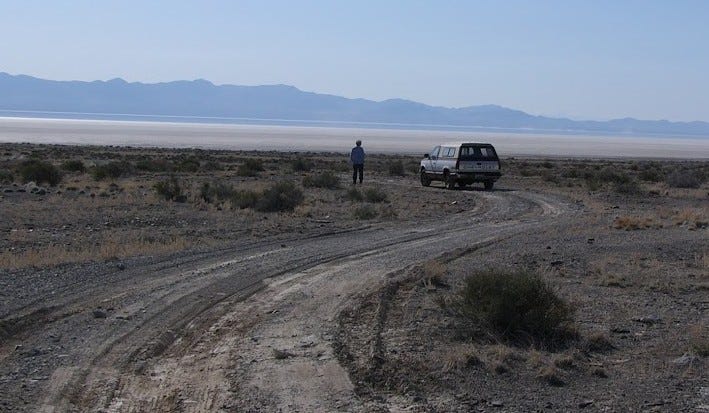
This is not a photo of Lake Ontario at some point in the future (hopefully!) Rather the “lake” in the distance is an “inferior” mirage of the sky seen as water somewhere out west.
Lake mirages occur most often in April, May, and June when the chill of winter lingers within the offshore waters and long hours of strengthening sun warm the air. Mirages are most likely whenever there is a sharp contrast in temperatures between air and water. Often the mirage is of land normally invisible below the horizon that appears as a dim narrow blue band just over the water. It may look like a fog bank or a dark streak. Sometimes, too, you may see a magnified or distorted boat in the distance.
Mirages on the lake can be spectacular. An neighbor of mine told once of seeing many years ago on a bitter cold winter morning a mirage of the Canadian shore. The landscape was greatly magnified and so sharply detailed that she could even see cars moving along the streets. And the whole landscape appeared to be upside down. Another winter mirage of Canada made the Rochester newspaper in the 1880s it was so clear and vivid and so widely seen. I once saw an upside down mirage ship once. It was paired with a rightside up image but magnified of itself.
In 1856 theLockport Journal reported an August mirage as quoted in Great Lakes shipwrecks by William Ratigan;
“It occurred just as the sun was setting, at which time some twelve vessels were seen reflected on the horizon, in an inverted position, with a distinctness and vividness truly surprising. The atmosphere was overcast with a thick haze such as precedes a storm, and of a color favorable to represent upon the darkened background, vividly, the full outlines of the rigging, sails, etc., as perfect as if the ships themselves were actually transformed to the aerial canvas.”
Last spring I saw several striking mirages while out with the boat. The first of these occurred on a bright sunny afternoon of light wind and cold water. Distant flat topped mesas and huge buttes of tawny brown and dark green to the west of me towered many hundreds of feet in the air. A few isolated spires and columns also appeared, and the more distant headlands showed a distinct horizontal dark line like a layer of smoke trailing off over the water from the top of the mountainous horizon.
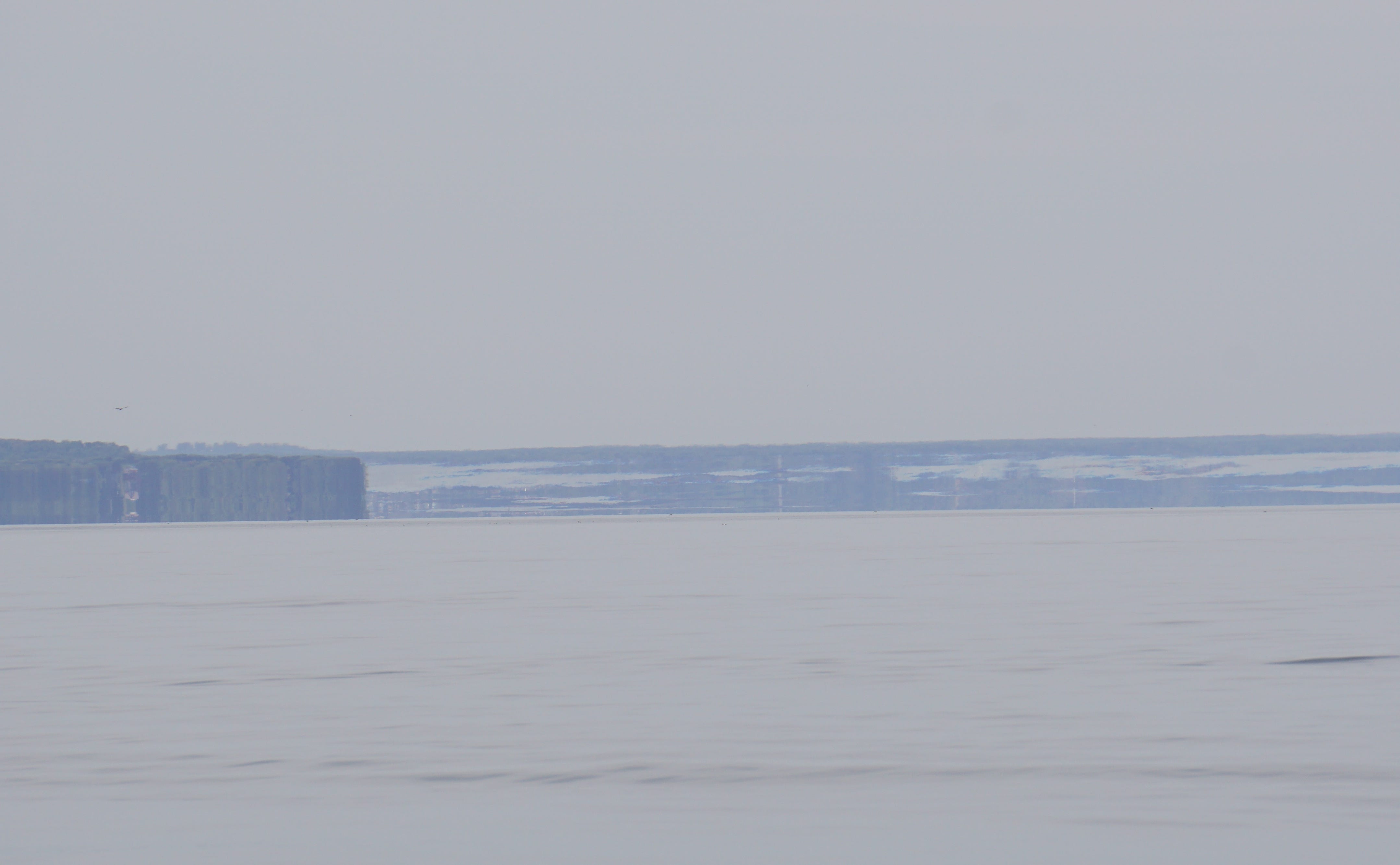
Photo- I took this from beach elevation- it shows two different distortions from a looming (superior) mirage. The closer bluffs have transformed into giant vertical escarpments while the distant coast mirage looks like perhaps two layers of different air temperatures. Is one image also inverted?
Occasionally, as I studied this improbable scene, a little piece of a mesa top would detach itself and seem to float up and dwindle away. The whole thing kept changing continually, but the shifts were so gradual and subtle that it was almost impossible to track them. It was as if the front range of the Rockies had suddenly erupted out of the lake along the Wayne County shore.
There also appeared a transition zone where a band of luminous aqua colored mist obscured the land before it appeared as prosaic hills and bluff faces. This “phantom mist” seemed to shield the transition between normal looking land and the craggy jagged changing mirage land a little ways to the west. Try as I might I couldn’t penetrate this mist with binoculars, though it seemed to me this held the key to understanding the baffling, shifting, wonderfully strange distant landscape. I saw no fairy castles of the fata morgana that day, but I did see a shore that would have been a credit to New Mexico’s best land of enchantment or that of the sandstone arches and pinnacles of Utah’s deserts.
There are of course, well understood explanations for these phenomena, superior and inferior mirages, changing refractive indexes and all that. To my mind understanding the optics renders these things no less wonderous. In fact, if you understand a little of what’s going on you can even experiment a bit with the mirage. Changing your height above the water often alters the images before you. Shifting up and down just a foot or two can make a big difference in what you see. I am no optics expert but with the help of Marcel Minnaert, author of Light And Color in the Outdoors here’s a brief optical excursion into the science of the miraculous and enchanting phenomena of the mirage.
Minnart’s book contains a photo of a mirage very much like those I’ve seen over the lake. It shows an island with not one but several inverted and compressed images hanging above it. Minnaert explains that if more than one layer of air of different temperature lies over the water you may get these multiple images, and he says they are also sensitive to the height of the observer. I can attest to this. A couple years ago one April afternoon we observed a distinct layer like a dark narrow cloud bank lying over the water as we stood about 80 feet above its surface on a bluff. We debated as to whether it was a mirage perhaps of Canada, or a patch of fog out over the cold water. We then hiked down to the beach and upon looking out at the horizon again, it appeared completely normal.
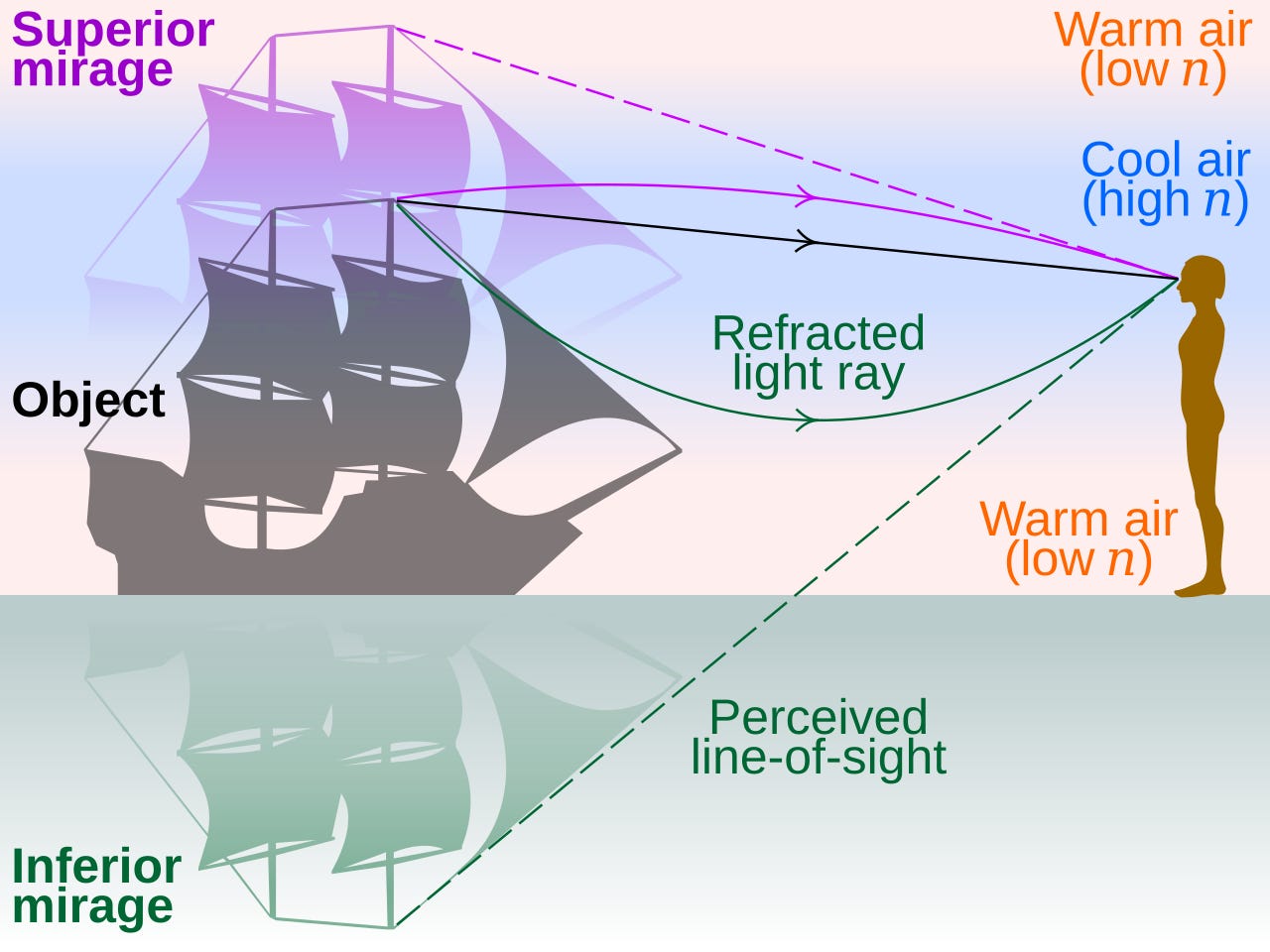
diagram from Wikipedia
Our Lake Ontario mirages are usually the “superior” type where something below the horizon appears to float above it inverted. The “inferior” mirage is seen where cold air lies over a sharply warmer surface such as a concrete road or a large area of desert basin. Minnaert says you need a temperature difference of 10 to 20 degrees F to see a really strong mirage. The silvery puddle on the road effect is actually the distant sky being reflected by this sharply different air layer acting as a lens to bend the light.
The best conditions for seeing a mirage on the lake are calm days when there isn’t a lot of wind to mix the thermal layers of atmosphere near the lake surface. Most of the ones I’ve observed have been early in the sailing season when we can easily get that required 20 degree difference between the air right over the cold lake and the air a foot or so above.
This article was adapted from my book Legends and Lore of Lake Ontario published by Arcadia Press in 2012